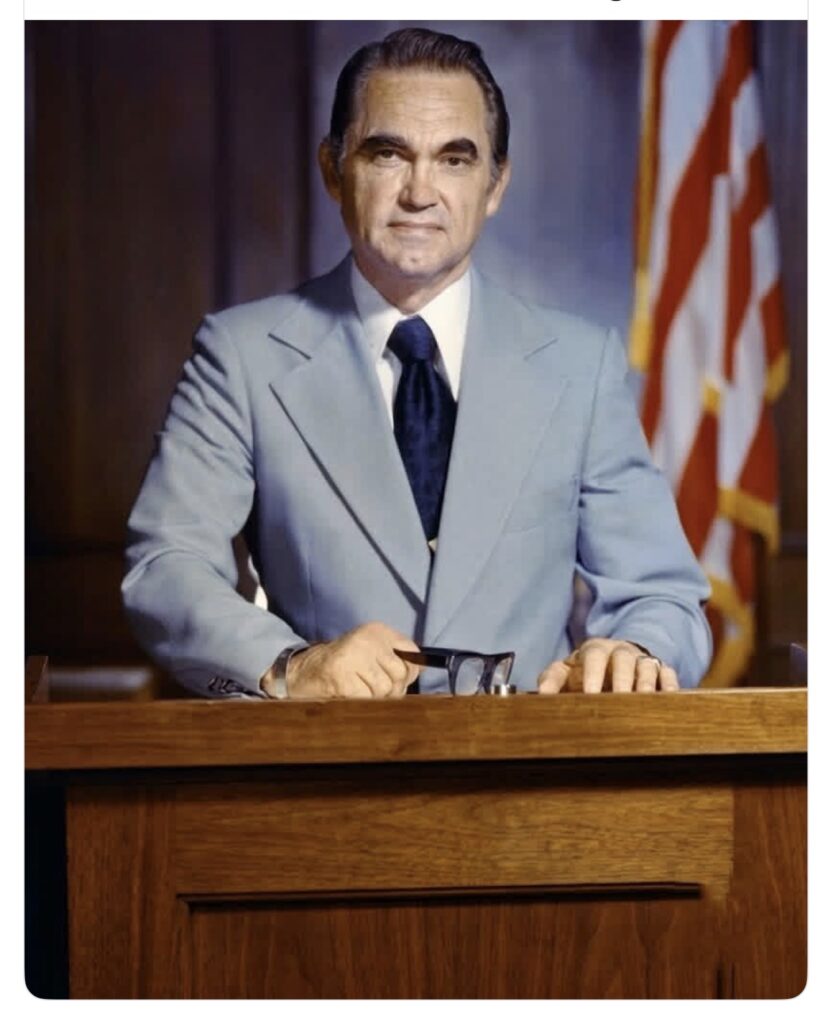
I knew the Wallace family from my family’s hometown. I visited Lurleen and children with our 4th grade girl scouts and Daddy and I went to see him in his final years before his death in Montgomery. He did suffer in this life but found peace. CBB. 7/16/26
“In June 1963, Alabama Governor George Wallace stood in the sweltering heat at the entrance of the University of Alabama’s Foster Auditorium, flanked by state troopers in a carefully staged piece of political theater. Billed as the "Stand in the Schoolhouse Door," this public blockade was designed to fulfill a campaign promise to protect "segregation forever" by physically barring two Black students, Vivian Malone and James Hood, from enrolling.
Wallace’s defiance, however, was short-lived. Once President John F. Kennedy federalized the Alabama National Guard, Brigadier General Henry Graham politely but firmly ordered the governor to step aside. Wallace complied, allowing the rule of law to prevail and the students to successfully register. It was a moment that permanently etched Wallace into the global consciousness as the rigid, unyielding symbol of Jim Crow resistance.
Yet history loves a structural twist, and the arc of Wallace’s life would take a sharp, agonizing turn. After surviving a 1972 assassination attempt that left him paralyzed and in perpetual physical torment, the combative politician began a profound internal reassessment. By the late 1970s and extending into the 1990s, a visibly altered Wallace began making quiet, personal rounds to seek redemption.
He didn't just issue blanket press releases; he sought out the very individuals he had wronged. Wallace personally reached out to both Vivian Malone Jones and James Hood to express deep, unprompted regret for his past actions. When Hood met with his former oppressor in 1996, he walked away convinced that the old governor’s remorse was entirely detached from political pragmatism it was a genuine reckoning with his own mortality.
The final act of this decades-long narrative culminated in a staggering, full-circle moment. In 1997, James Hood returned to the University of Alabama to earn his Ph.D. in interdisciplinary studies. In a twist of fate that defied the optics of 1963, a frail Wallace had planned to personally hand Hood his doctoral degree on the graduation stage, though failing health ultimately kept him from attending.
When Wallace passed away the following year, Hood sat among the mourners at the funeral. By offering a public eulogy that implored the world to forgive a man who had fundamentally changed, Hood didn't just close a chapter on a polarizing figure; he effectively conquered the legacy of the schoolhouse door, proving that the ultimate subversion of hatred is the active choice of grace. “ from a FB srticle